
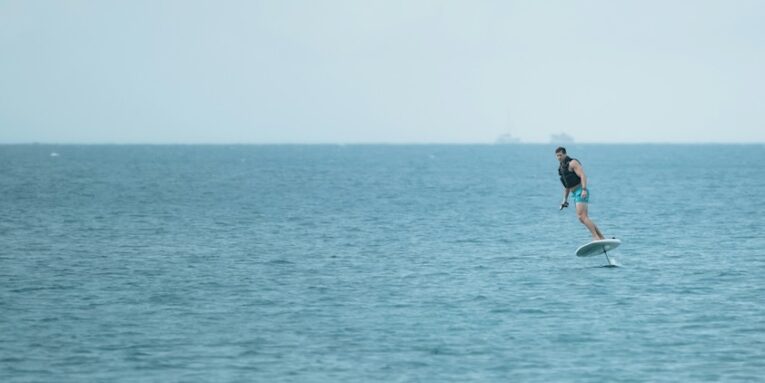
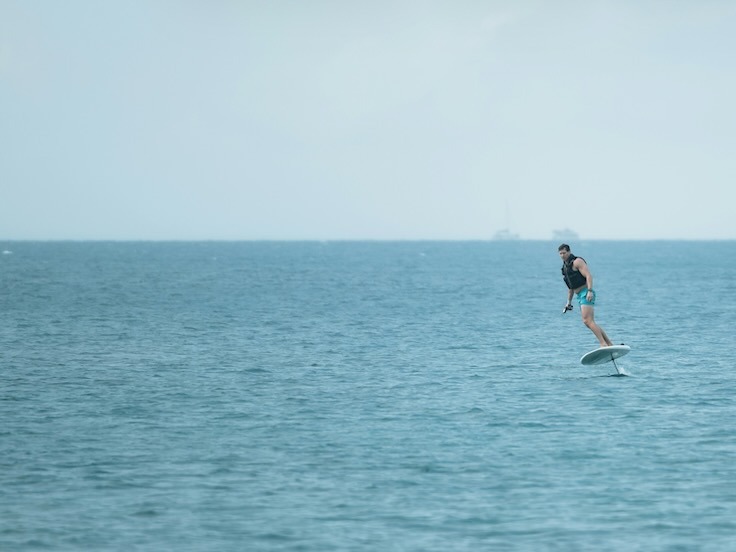
The first time most people see an eFoil, they assume something has been edited out of the video. A rider stands about half a metre above flat water, moving at the speed of a bicycle, and there is no sail, no wave, no towrope, and almost no wake. The board is simply not touching the surface.
Nothing has been edited. What is happening underneath is closer to aviation than to boating. An electric hydrofoil board carries a small wing on a vertical strut below the hull, and once the board reaches a certain speed, that wing generates enough lift to carry the rider and the board clear of the water. Everything else about the sport, including how long it takes to learn and why it sounds like almost nothing, follows from that one fact.
Here is how the machine works, what learning it actually involves, and what a beginner should understand before ever getting near one.
The six parts of an eFoil
Strip an eFoil down and there are six components that matter.
- The board is the platform you stand on. It floats, and its volume determines how stable it feels at low speed, which is why beginner boards are noticeably larger than the ones experienced riders use.
- The mast is the vertical strut running down from the underside of the board. Typical lengths sit somewhere between 60 and 80 centimetres, and that measurement sets how high above the water you can fly.
- The front wing is the part doing the real work. It generates the lift, and its size and profile shape almost everything about how the board behaves.
- The rear stabilizer sits behind it and controls pitch. It works like the horizontal tail on an aircraft, damping the tendency of the board to porpoise up and down.
- The drive unit provides propulsion. Manufacturers take two broad approaches here, which is worth understanding before you buy anything.
- The battery and remote control complete the system. The battery sits in a sealed compartment inside the board, and the throttle lives in a waterproof handheld remote, so power is controlled with your thumb rather than your feet.
Why the board leaves the water
A hydrofoil is a wing operating in water instead of air. As the foil moves forward, it deflects the water passing over it and creates a pressure difference between its upper and lower surfaces. That difference produces lift, and lift increases sharply with speed.
The useful part is density. Water is roughly 800 times denser than air, so a foil the size of a dinner tray can produce enough force to carry an adult. Angle matters as much as size: engineering analyses of foil performance put the best lift-to-drag ratio at an angle of attack of only about three to four degrees, with stall setting in somewhere around fifteen. That narrow window is exactly what the rear stabilizer exists to protect, and it is why small shifts of body weight have such a large effect. For a readable technical breakdown of the underlying fluid dynamics, MIT’s hydrofoil overview covers it well.
Every ride passes through three phases. The board starts in displacement, pushing water aside like any hull. As power increases it moves into planing, skimming along the surface. Somewhere around 20 to 25 km/h, depending on rider weight, board size, and wing choice, the foil produces enough lift for the hull to leave the water entirely and the board begins foiling.
At that point drag collapses. There is no hull carving through water anymore, only a thin strut and a wing. This is why an eFoil at cruising speed is close to silent, and why range improves once a rider is up and flying rather than ploughing along at half throttle.
What learning actually looks like
The learning curve is unusual because it is steep at the start and then very short. Most people fly within their first two sessions. Riding well takes considerably longer.
The standard progression runs like this:
Lying down. You start flat on the board, hands on the handles, getting used to how the throttle responds. The goal is nothing more than a feel for acceleration.
Kneeling. Weight shifts onto the forearms, then the knees come forward to the middle of the board. Power is stepped up gradually while keeping the board flat by leaning forward as it accelerates.
Standing on the surface. Front foot roughly where your hand was, back foot behind it, wide stance, knees soft. At this stage you are planing at a steady 20 to 25 km/h, not flying, and staying there deliberately until it stops feeling precarious.
The first flight. A small backward shift of weight lifts the nose. The correct reaction is not to panic but to come gently forward again and set the board back down. Repeat, and let the flight phases get longer each time.
First turns. Weight shifts through the heels for one direction and toward the toes for the other, with the eyes pointed where the turn is going. One side always feels easier than the other at first.
The point worth making to anyone considering the sport is that it rewards balance and patience rather than strength. Slow, controlled movements produce faster progress than aggressive ones. That is also why the age and fitness range of riders is much wider than in surfing or kitesurfing.
Drive systems and the safety picture
Propulsion is where designs diverge most. Some eFoils use a propeller, either exposed or behind a guard. Others use a fully shielded jet drive integrated into the mast, with no exposed blades at all. The tradeoff is straightforward: a guard is a component that needs inspecting for gaps and damage, while a shielded jet design removes the blade exposure but still requires attention to seals and wear. Manufacturers also differ in how they sell the rest of the hardware. Some let you assemble a setup component by component, while eFoil boards from Aerofoils and several others ship wings as complete, factory-matched sets, on the reasoning that the front wing and stabilizer are tuned to work as a pair.
Whatever the hardware, the safety fundamentals are the same:
- Wear a helmet and a certified buoyancy vest every session. The BoatUS Foundation’s life jacket guidance is a good starting point on choosing one that actually fits.
- Ride in water at least 1.5 metres deep across the entire area you plan to use, not just where you launch. Sandbanks further out carry the same risk to rider and equipment.
- Never go further from shore than you could comfortably swim back.
- Treat the battery seriously. Charge it in a cool, dry place, never unattended, and stop using it entirely if it has been dropped.
Where you can legally ride
This varies more than newcomers expect. Rules differ between countries, between states or regions, and sometimes between individual lakes.
The variables that determine it are consistent, though: the motor’s power output, whether the water is inland or coastal, whether the area is a nature-protection zone, and what the local waterway authority permits. Busy inland lakes and protected reserves are the two most common places where riders discover the answer is no.
The practical advice is to check the specific body of water you intend to ride before buying anything, not after delivery.
The ownership realities
A few things rarely come up in the footage.
Rigid setups are heavy. Moving one usually means a roof rack, a van, or a second pair of hands, which is why inflatable eFoil boards exist as a category. Charging time is the real limit on a full day out, not battery capacity. Saltwater demands a rinse-and-dry routine after every session, with electrical contacts kept completely dry. And over winter, lithium batteries want to be stored partially charged rather than full or empty, with a periodic check on their level.
None of this is difficult. It is just a maintenance habit, and it is the difference between a board that lasts and one that does not.
So is it worth trying?
The reason an eFoil looks impossible is that it genuinely is flight, carried out in a fluid 800 times denser than the one aircraft use. That density is what allows a wing small enough to carry under one arm to lift an adult clear of a lake.
It is also what makes the sport unusually accessible. There are no waves to wait for, no wind to depend on, and no years of practice required before the first good session. For anyone who has ever watched a foiler drift past in silence and wondered what that feels like, the honest answer is that it feels like very little at all, which turns out to be the whole appeal.
People also read this: Why the Best Business Podcasts Sound Like Keynotes: The Storytelling Overlap Reshaping Audio
