

A dirty building costs you more than it looks like it should. Sick days climb, turnover creeps up, a client walks through the lobby and silently downgrades their impression of the company, and somewhere in the middle of all that, a slip on a wet floor turns into an insurance claim nobody budgeted for.
So the question every operator eventually asks is the same one: do you hire people to clean the building yourself, or do you pay someone else to do it?
It sounds like a simple choice. Yet, the two models look similar on a spreadsheet and behave very differently in a building.
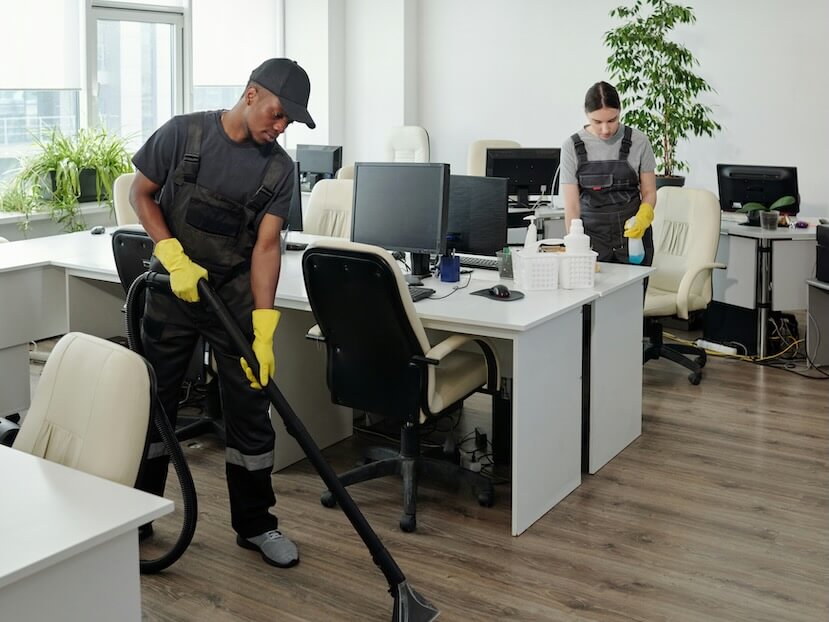
The Real Money Is Not Where You Think It Is
On paper, an in-house crew looks cheaper. You know the hourly wage, you know the headcount, and you can add it up. Outsourced pricing shows up as one monthly invoice that often seems higher than the wages alone.
Then you start counting the things the invoice already covers. Payroll taxes and workers’ comp. Uniforms, chemicals, equipment, training, and supervision. The floor scrubber that sits broken for three weeks. The supervisor’s time when someone quits and you have to hire again.
Once those are on the same line, the gap narrows and sometimes flips.
Commercial cleaning is also a much bigger business than most owners realize, which matters because scale is what lets outside vendors buy equipment and chemicals cheaper than you can. A vendor working inside that market gets buying power a single building rarely has on its own.
Control Sounds Great Until You Have to Use It
The strongest argument for keeping cleaning in-house is control. Your people, your standards, your schedule, your priorities. When something needs to change, you change it in a meeting instead of in a contract.
The catch is that control is only useful if you actually exercise it. Most operators don’t want to run a cleaning department. They want the building to be clean.
If nobody on the leadership team is genuinely paying attention to floor care schedules, restroom checks, and disinfection protocols, in-house control becomes in-house drift. A vendor’s contract, by comparison, gives you something to hold up and point at.
Expertise Belongs to Whoever Does It Every Day
There’s a real difference between wiping a surface and reducing what lives on it, and the surfaces that matter most in an office are rarely the ones people focus on. Phones, keyboards, and shared handles usually beat the restroom, too.
That kind of knowledge lives with people who clean full-time for a living. An in-house crew can absolutely get there, but only if you invest in real training and keep the same people long enough for it to stick. Turnover is what erodes expertise fastest. Every departure resets the clock.
Where Each Model Actually Wins
The honest answer is that neither model wins across the board. They win in different places, for different reasons.
- In-house wins on single, complex sites. One large campus with unusual security, research work, or 24-hour operations often runs better with staff who only ever work that building and answer directly to facilities.
- Outsourced wins on multi-site portfolios. Once you’re managing more than a couple of locations, a commercial cleaning partner with regional coverage handles hiring, coverage gaps, and consistency across sites in a way an internal team almost never matches.
- In-house wins on tight confidentiality. Legal, defense, and some medical settings have reasons to keep every set of hands inside the org chart.
- Outsourced wins on variable demand. Post-construction cleanups, seasonal deep cleans, and pressure washing are hard to justify staffing for internally. They’re exactly what vendors are built to absorb.
The mistake is picking one on principle and defending it. Pick the model that fits the building you actually have, revisit it when the building changes, and be willing to run a hybrid when a hybrid is what the math supports.
People also read this: Aircraft Brokerage Services: What Private Clients Should Expect
