
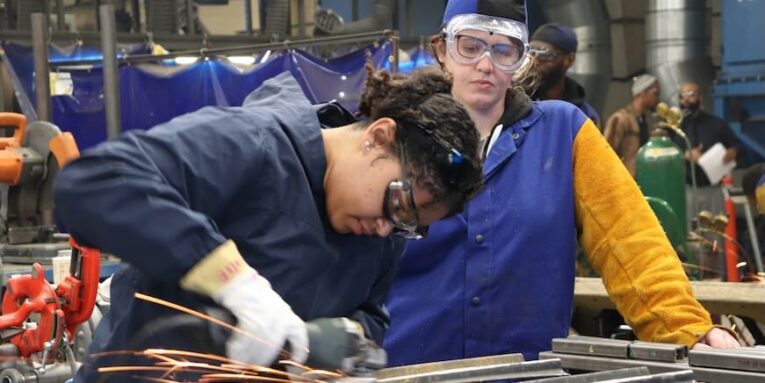
The skills gap continues to be one of today’s largest employment challenges.
Employers from every sector are having difficulty hiring workers with necessary hands-on skills. Skill gaps are only continuing to grow more prevalent every year. A recent study found that 87% report skills gaps in their workforce.
Here’s the good news:
Here come the vocational schools. Teaching trades to tomorrow’s workforce. Filling the void one tech cert at a time. Even better, they’re doing it quicker and at less cost than universities.
Learn how trade schools are helping solve the skills gap crisis. Also learn which trades are in high demand today.
Let’s get into it…
Here’s what this guide covers:
- What Is the Skills Gap (And Why It Matters
- Why Vocational Schools Are Filling the Gap
- How Technician Certification Programs Work
- Top Trades Driving the Vocational Boom
- Real Benefits for Students and Employers
What Is the Skills Gap (And Why It Matters)
Skills gap is the difference between skills required by employers and skills possessed by employees.
Pretty simple, right?
Except it’s a massive problem. The skills gap could cost businesses $8.5 trillion worldwide by 2030 if left unaddressed. Holy cow, that’s a lot of money out of the economy and workers.
So what’s causing it?
A few things:
- Retiring baby boomers are leaving the trades faster than they can be replaced
The degrees pushed for years have been four-year degrees. Trades have been lacking new blood
- Technology is changing faster than most schools can keep up with
That last one matters most. New careers in fields like HVAC, electrical and automotive are much more technical. Techs require certification in order to work with “smart” systems, or computer diagnostics.
Without skilled workers, businesses can’t grow. Projects get delayed. Costs go up. Everyone loses.
Why Vocational Schools Are Filling the Gap
Vocational schools are perfectly built to solve this problem.
Why? Because they teach job-ready skills. No 4 years of theory. No mountain of student loan debt. Just training that prepares you for a career.
Students are starting to realize it too. Schools like HVAC Training Classes are enrolling more students than ever because they provide accelerated, skills specific technician training that places students in high-demand, well paying jobs ASAP. Schools with programs like this are training students for the jobs that employers are currently hiring for.
Look at the numbers…
Vocational school enrollment grew 13.6% in 2024, reaching 923,000 students. Two consecutive years of double-digit increases. Students are speaking loudly through their actions (and tuition payments).
The reason is simple. Vocational schools offer:
- Shorter program times (most under 2 years)
- Lower tuition costs than universities
- Direct paths into high-demand careers
- Industry-recognized credentials that employers actually want
That last bit is important. Technical certification from a reputable trade school really speaks to employers. It means you’re able to work day one.
(Try saying that about a four-year liberal arts degree.)
How Technician Certification Programs Work
The majority of technician certifications programs are fairly similar in structure. Class time is mixed with real world hands-on experiences.
Here’s the typical setup:
- Classroom instruction – Cover the basics like safety, codes, and theory
- Lab work – Practice on real equipment in a controlled space
- Apprenticeship or externship – Get on-the-job experience with a working pro
- Certification exam – Earn the credential that proves you’ve got the skills
Completion time is from 6 months to 2 years. Much quicker than a conventional degree.
Plus the certification you earn is gold. Employers know what it means. They know what you can do. They know they won’t need to spend months training you.
It’s a much better deal for everybody involved.
Top Trades Driving the Vocational Boom
Not every trade is booming equally. Some are growing way faster than others.
Here are the trades that are leading the way:
- HVAC technicians – Around 40,000 annual job openings are projected through 2033
- Electricians – Expected to grow 11% by 2033, much faster than average
- Diesel mechanics – Massive demand from the trucking and logistics industries
- Welders – Construction, manufacturing and infrastructure projects all need them
- Plumbers – An aging workforce means tons of openings popping up
HVAC school is booming. Applications to HVAC programs rose 27% in 2024, which is 41% higher than they were in 2020. Something big is going on.
Why such big numbers?
A few reasons:
- New construction is booming across the country
- Old HVAC systems need replacing in homes and offices
- Green energy upgrades require trained techs
- Older techs are retiring in waves
Got aspirations to make a career change? These are the trades with the best opportunities available. Great pay. Great demand. An opportunity to advance.
Real Benefits for Students and Employers
Vocational education doesn’t only benefit students. It benefits the economy as a whole. There are advantages on both sides of the ledger.
For students, the benefits include:
- Less debt – Cheaper tuition and shorter programs
- Faster careers – Most grads are working within a year
- Job security – Skilled trades aren’t going anywhere
- Good pay – Many trades pay well above the national average
For employers, the wins are:
- Job-ready workers – No need to spend months on basic training
- Lower turnover – Trained workers tend to stick around longer
- Filled positions – Less time leaving projects short-staffed
- Higher productivity – Skilled techs get more done in less time
It’s truly a win-win.
Especially as more vocational schools form partnerships directly with employers. Students are learning on equipment they will be using while on the job. Employers can influence what’s being taught in the classroom. That type of collaboration is what has been needed for years.
That’s how you close the skills gap.
Tying It All Together
The skills gap is real, but vocational schools are showing they have the answers.
Balancing technician training with workforce placement, these schools are providing training with an eye towards immediate employment. Accelerated training programs give technicians the skills they need to go right to work in a high-demand career. It’s good for students and businesses. Plus, it makes sense.
To quickly recap:
- The skills gap is costing the global economy trillions every year
- Vocational schools train students faster and cheaper than universities
- Technician certification gets workers job-ready quickly
- HVAC, electrical, diesel and welding are some of the hottest trades right now
- Both students and employers win when training matches industry needs
When considering a new career path (or entering the workforce), vocational training may be your best option. There’s a need for it. Opportunity exists. Jobs await.
People also read this: Why Hiring SLP Services Is a Big deal for Communication
