
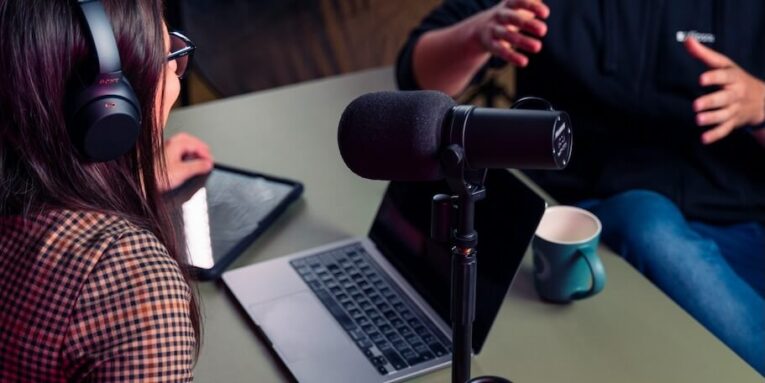
The corporate podcast has grown up. What started as a marketing experiment a decade ago is now a standing line item for companies from ten employees to ten thousand, and somewhere along the way the format quietly changed underneath everyone: the podcast became a video product. Clips on LinkedIn, full episodes on YouTube, audiograms in the newsletter, stills in the sales deck. Audio-only is still a perfectly good way to start. It is no longer the way the winners operate.
You can see the shift in how the question gets asked. Five years ago, leadership teams debated whether the company should have a podcast at all. Today the debate is why the one they have is not producing anything the rest of the company can use. Almost every time, the answer is the same: the conversation was recorded in a format that can only ever become one thing.
This piece is the case for filming, and just as importantly, the production playbook for doing it without flattening the conversation into a corporate infomercial nobody finishes.
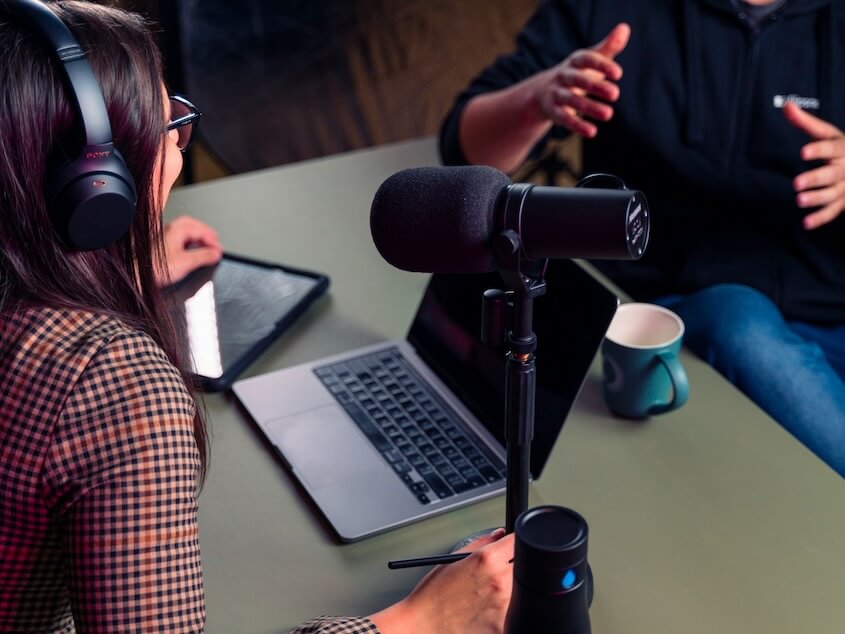
The math of one filmed hour
Start with the arithmetic, because it settles most of the argument on its own. A single one-hour filmed conversation yields: the full episode for YouTube and the company site, the audio feed for Spotify and Apple, six to ten vertical clips for LinkedIn, Reels, and TikTok, a handful of quote graphics, pull-quotes for the newsletter, and stills of the guest and host for every channel the company runs. Cut well, one recording session feeds a month of publishing.
The same hour recorded as audio yields one asset, maybe two if someone turns a quote into a graphic. When a leadership team asks what the podcast is actually doing for the company, the video version has ten answers and the audio version has one. That difference, repeated every episode for a year, is the entire gap between podcasts that survive budget season and podcasts that do not.
The mistake companies make first
The instinct, once video enters the plan, is to build a studio. A conference room gets converted. Gear gets ordered, usually twice, because the first order was wrong. Acoustic panels appear on a wall that still echoes. And six months later the room has hosted four episodes, because getting three busy people into the same corner of the same building at the same hour turns out to be the hardest production problem in corporate podcasting.
The room was never the bottleneck. The calendar is the bottleneck. Executives, customers, and outside guests do not skip recordings because they dislike the podcast; they skip them because the podcast is a commute. Any production plan that begins by adding a commute has designed its own failure into the schedule before the first episode is cut.
Bring the studio to the guest
The production industry’s answer to the scheduling problem has been to invert it: instead of moving people to the studio, move the studio to the people. Image Media Lab, a Dallas production company that has filmed executive interviews for over a decade, built a mobile podcast lounge for exactly this reason: a full multi-camera recording setup, lighting, sound treatment and all, that rolls into an office, a conference, or an executive floor, so the episode happens where the guests already are.
Founder Sem Maltsev, whose team has spent thirteen years producing a long-running interview series with leading figures in medicine, puts the logic plainly: “Executives do not skip recordings because they dislike the podcast. They skip them because the podcast is a forty-minute drive. Remove the drive and the calendar problem disappears. The episodes that never happen are the most expensive episodes of all.”
Whether a company hires a crew, builds a cart of its own, or books a traveling setup, the principle is the one to keep: design the production around the guest’s day, not around the room.
Filming without flattening
The legitimate fear about adding cameras is that they change the conversation. They do, for about five minutes. The difference between a filmed podcast that feels alive and one that feels like a hostage video is almost entirely a set of production habits, and none of them are expensive.
Light the room, not the faces. Soft, even lighting that leaves the space feeling like a room rather than a set keeps guests from performing. If the setup looks like a broadcast desk, expect broadcast answers. The goal is a room that happens to be filmable, not a set that happens to contain people.
Roll early, roll through. Start recording during the small talk, before anyone announces anything. The moment a producer says “we’re rolling,” every guest in the world sits up straighter and forgets their best story. Storage is cheap. Second takes of honesty are not. Some of the best moments in any filmed conversation happen ninety seconds before the interview officially begins.
Two cameras minimum, three when there is a host. The cutaway is what makes a filmed conversation watchable, and it is also the editor’s escape hatch. With one camera, every stumble requires a restart, and every restart costs the guest a little more spontaneity. With two or three angles, the conversation simply keeps moving and the edit disappears the seams.
Keep the crew invisible after the first ten minutes. A crew that keeps adjusting, repositioning, and whispering keeps reminding the guest they are being watched. The best filmed podcasts feel unattended. Set the room, check the frame, then sit down and let the conversation forget you. That discipline earns answers a boardroom never hears.
The gear conversation nobody needs to have
Somewhere in every planning meeting, an hour disappears into camera brands. It is the most comfortable conversation in the project and the least important. Audiences in 2026 forgive ordinary picture instantly; they abandon bad sound in seconds; and no camera at any price can rescue a host who is reading questions off a sheet.
The minimum spec that actually matters: clean, individually miked audio for every voice in the room, two matched camera angles, and light that flatters faces without interrogating them. Everything above that line is refinement. Everything below it is damage. Companies that hold the gear budget flat and spend the difference on a better interviewer, a better editor, or simply more episodes see the difference on every chart that matters. The conversation is the product; the equipment is packaging.
What to actually publish
The full episode is the archive. The clips are the product. Treating every recording as a content sprint is what separates the filmed podcasts that compound from the ones that just accumulate.
A cadence that works, over and over: the strongest 60 to 90 seconds go to LinkedIn within two days of the recording, while the topic is still warm and the guest is still excited enough to reshare it. Three or four more clips get scheduled across the following weeks, each cut around one idea with a caption that stands on its own. The full episode lives on YouTube and the company site with proper chapters and a real title, not “Episode 14,” because nobody searches for Episode 14. Quotes become graphics, the transcript becomes a post, and the best exchange becomes the newsletter’s opening item.
Then the quiet second life begins. A well-filmed episode library becomes some of the best sales enablement material a company owns. Sales teams send specific clips to specific prospects: the CEO on pricing philosophy, the head of engineering on reliability, a customer telling their own story unprompted. A prospect who has watched the CEO think out loud for forty minutes arrives at the first meeting already half convinced, and the meeting starts three steps further down the road.
Measure it like an executive, not like an influencer
Filmed podcasts die in budget reviews when they are defended with influencer metrics. Downloads and view counts are weather; they move for reasons nobody controls and impress nobody who signs budgets. The numbers that keep a corporate show alive are pipeline numbers.
Track how often clips get sent by the sales team, and to whom. Ask new customers, in the standard onboarding survey, whether they watched anything before buying. Watch for the episode that a prospect quotes back in a meeting. Count the guests who became partners, hires, or customers after sitting for an episode, because inviting exactly the people the company wants a relationship with is the most underrated targeting mechanism a B2B brand has. One enterprise deal that arrives warmer because of forty minutes of filmed conversation pays for a year of production, and unlike weather, that arithmetic survives scrutiny.
Where corporate podcasts go to die
The failure modes are so consistent they can be listed in advance. The show launches with a burst of enthusiasm and dies at episode six, when the novelty wears off and no one owns the calendar; the fix is scheduling recordings in batches, two or three conversations in a single day, so the pipeline is always four episodes deep. The host is chosen by title instead of curiosity, and every episode sounds like a quarterly review; the fix is giving the microphone to the person who genuinely wants to know the answers, whatever their business card says. The questions get scripted into oblivion by committee; the fix is an outline of destinations rather than a script of sentences. And the show gets treated as a campaign with an end date instead of a channel with a compounding audience; the fix is deciding, before episode one, that the unit of success is the year, not the episode.
None of these are production problems, which is exactly the point. Film solves distribution. Only conviction solves longevity.
Start smaller than you think
None of this requires a broadcast budget or a twelve-episode commitment. It requires one well-produced pilot: a real conversation with a guest worth hearing, filmed properly, cut into its clips, and measured honestly against whatever the company is currently posting. Run that experiment once and the comparison is rarely close. The pilot episode of a filmed podcast routinely outperforms months of ordinary corporate content, because it contains the one ingredient the rest of the feed lacks: people actually thinking.
The conversation is the asset
Companies do not lack stories. They lack formats that let the stories out. A filmed conversation is the lowest-friction, highest-yield format corporate content has ever had: one hour, one room, one honest exchange, and a month of material that sounds like human beings.
The conversation is the asset. Filming it is simply refusing to leave most of its value in the room.
People also read this: Why Digital Banking Is Ideal for First-Time Bank Account Holders
 - https://epodcastnetwork.com/why-smart-companies-film-their-podcasts-and-how-to-do-it-without-killing-the-conversation/)