

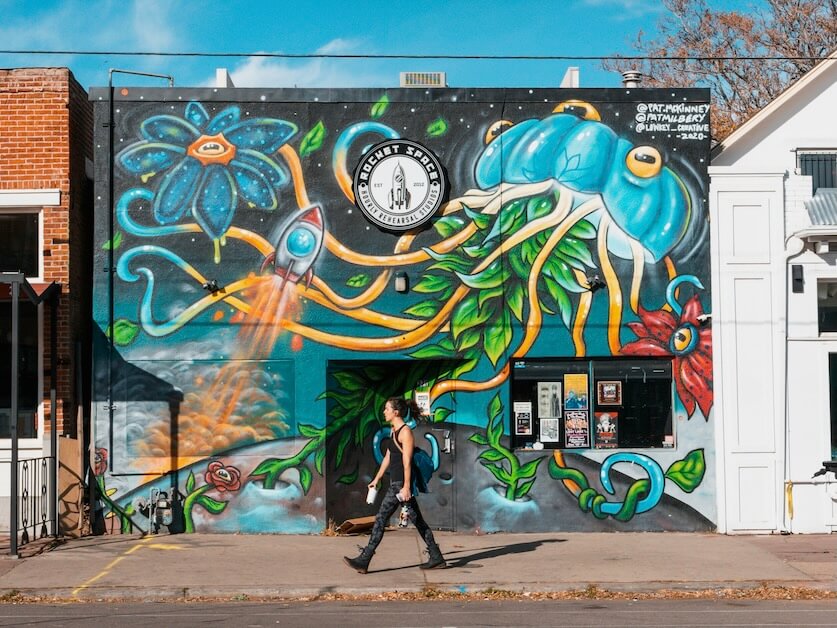
Everybody who moves to Denver gets pointed at RiNo within about a week. It is the neighborhood people photograph. Murals on every third wall, a taproom on every second block, rooftops that did not exist five years ago. The pitch sells itself, which is exactly why it deserves a slower look before you sign a lease.
RiNo is a genuinely good place to live. It is also a specific place to live, with tradeoffs the highlight reel leaves out. Here is what the neighborhood asks of you in return.
The Warehouse Bones Are Not Decoration
Start with what the place used to be, because it explains nearly everything about how it feels now.
Through the late 1800s and most of the twentieth century, the ground north of downtown along the South Platte was Denver’s industrial back office: factories, rail yards, warehouses, repair shops. It sat where it sat because the river and the rail lines were there. Nobody was building charming.
The River North Art District was formally designated in 2005. The RiNo Art District organization puts the boundaries at roughly Interstate 70 to the north, Interstate 25 to the west, Park Avenue West to the south, and Arapahoe Street to the east, which works out to about a square mile of former industrial land.
That history has a practical consequence people miss. RiNo’s blocks were laid out for trucks and rail spurs, not for strolling. Some streets are continuous and lovely. Others dead-end into a loading dock or hit a rail crossing that adds four minutes to a walk that looked like two on the map. Walkability here varies block by block in a way it does not in Wash Park or Congress Park. Walk the exact streets you are considering, at the hour you would really walk them.
What Fills the Buildings
The reason RiNo did not turn into a generic mid-rise district is that a lot of the original structures survived and got reoccupied rather than replaced.
The clearest example sits at 3300 Walnut. According to 5280 magazine, the building went up in 1929 for the Liquid Carbonic Corporation, a Chicago company that made dry ice there for the first soda machines and bottled CO2 for regional soda fountains. Dry ice shipped out of it for railcar refrigeration and household ice boxes. A father and son bought the place in 2007 after city developers backed away from how much work it needed, and it now houses a co-op gallery, roughly two dozen artist studios renting between $375 and $1,100 a month, and a handful of other small tenants, including a denver personal training studio tucked into the base of the old towers.
That mix is the actual character of the neighborhood. Not the murals. The murals are downstream of the fact that the rent in a converted 1929 factory was, for a while, low enough that odd small businesses could take a floor.
The Murals Are a Moving Target
Neighborhood guides count more than 80 murals concentrated along Larimer, Walnut, and Blake between roughly 25th and 38th. The September festival that ran for years as CRUSH Walls, now programmed as Art RiNo, brings artists in to add and repaint work every fall.
Worth knowing: the wall you fell in love with may not be there next year. That is the design, not a failure of it. If you need your surroundings to hold still, this is information.
Getting In and Out
Transit is RiNo’s strongest practical argument. The 38th and Blake station puts you roughly ten minutes from Union Station and about thirty minutes from the airport on a single train, with no parking garage and no rideshare surge at 5 a.m.
Balance that against the rest of the picture:
- Parking is contested and getting more so. If you have two cars, price a deeded space honestly rather than assuming street parking works.
- I-70 and I-25 both border the district. Proximity to a highway is convenient and audible.
- Weekend nights on the Larimer and Walnut corridors are loud. That is the amenity you are paying for and the thing you will complain about.
- Grocery access is thinner than the restaurant density suggests. Map your actual weekly shop, not your Friday.
The Fifteen-Minute Radius Test
Here is the honest way to evaluate any RiNo address, and it has nothing to do with the unit.
Stand at the front door and map what you actually do in a week. Not what you would like to do. What you did last week. Coffee, groceries, the pharmacy, the place you meet friends, the gym. If four of those five land inside a fifteen-minute walk or a short bike ride, the neighborhood will work for you and the smaller floor plan will not matter.
If they do not, the murals will not save it. The difference between a denver personal trainer you see three times a week and one you see twice a month is almost never motivation. It is distance. Same with the friend you keep meaning to call and the restaurant you keep meaning to try. Distance does not cancel plans outright. It makes each one slightly expensive, and you make slightly fewer of them, and a year goes by.
Who RiNo Is For
If you want a yard, a quiet street, and a garage, there are better answers in Denver and you already know their names.
If you want to live somewhere with texture, where the buildings have a previous life and the ground floor holds businesses that could not afford a nicer address, where you can be at the airport in half an hour without touching a car, RiNo earns its reputation.
Just go on a Tuesday. Walk the block. Then decide.
People also read this: The Best Places to Buy Ammo Online
