
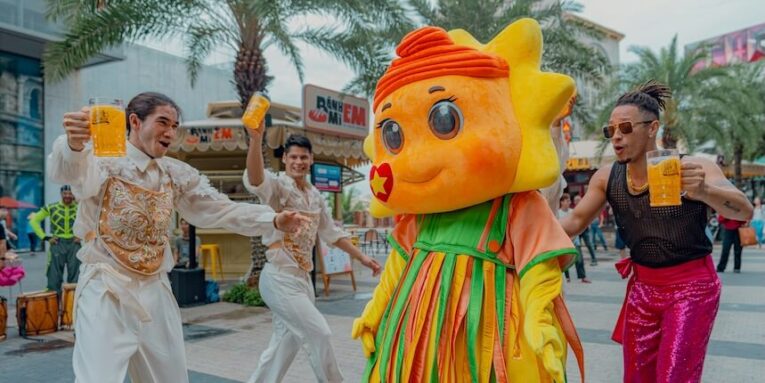
Every shore town has them. The oversized crab handing out flyers near the boardwalk ramp, the school character on the back of a flatbed in the Fourth of July parade, the seagull outside a bike rental shop who has clearly been doing this job for a decade. They are so much a part of the summer furniture that most people never stop to think about where they come from or who is inside.
They are, in fact, a small industry, and one that quietly does a lot of work for local businesses, schools and volunteer organizations along the Jersey Shore.
Why mascots persist in beach towns
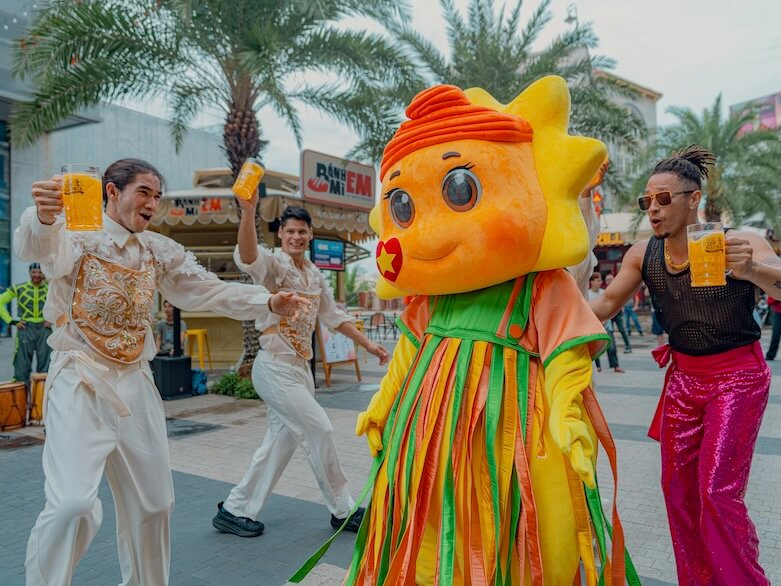
Shore economies have a specific problem: they need to make an impression on people who are here for four days and may never come back. A sign is easy to walk past. A person in costume standing near a storefront is not. For a family walking the boards with two tired kids, the character is often the reason they stop at all, and stopping is most of the battle.
There is a second, less obvious reason. Beach towns are photographed constantly. Every business on the boardwalk is competing for space in a stranger’s camera roll and, from there, in their social feed. A character is one of the few things that reliably ends up in family photos without anyone being asked to pose. That is free circulation of a business name to an audience that has no connection to Ocean City at all, and it costs nothing after the initial outlay.
It is not only businesses
Local organizations lean on them just as hard. Fire companies and first aid squads use characters for fire prevention week and water safety talks, where the goal is to hold the attention of a room full of six-year-olds long enough for the message to land. Schools use them at games, assemblies and fundraisers. Nonprofits use them at boardwalk fundraisers where the alternative is a folding table and a donation jar.
In all of those cases, the character is doing something a flyer cannot: giving a group an approachable face at an event where most people are not looking to be approached.
What it actually takes to run one
The romance of the mascot fades a little once you talk to the people who manage them. Two practical issues come up again and again.
The first is heat. A full-body suit in July on a boardwalk is a serious physical undertaking. Organizations that run a character responsibly work in short shifts, keep a spotter nearby who knows the performer is inside and cannot always signal clearly, and build in water breaks. This is not optional caution. It is the difference between a good summer and a hospital visit.
The second is the suit itself. A costume bought cheaply and used five days a week through a shore season will not survive that season in a presentable state. Salt air, sand and sun are hard on fabric, and a character that looks matted and grubby by August does the opposite of what it was bought for. Organizations that plan to use a character for several years generally do better with mascot costumes custom built to their design, because these are made with replaceable heads, hands and feet, and can be spot-repaired rather than replaced outright. Makers typically quote lead times running to a couple of months or more, which means a spring order for a summer season is cutting it close.
Designing something that lasts longer than a season
The characters that become genuinely local, the ones people recognize years later, tend to have something specific behind them. A regional animal, a piece of the town’s history, a nickname that already existed. Characters designed around a current logo or a marketing campaign tend to look dated the moment either one changes.
It is also worth thinking about who will wear it. Many shore organizations rely on high schoolers and volunteers, and a suit sized for one particular adult limits who can step in when that person is unavailable. Most makers can build in a range of adjustment if asked at the design stage, and it is much harder to retrofit later.
None of this is complicated, but it is the sort of thing that gets skipped when a character is ordered in a hurry in May. The businesses and organizations whose mascots people still remember are usually the ones who thought about it in February.
People also read this: Why Your Dryer Takes Two Cycles: The Lint, Vent and Sensor Faults Behind a Slow Dryer
