
Many businesses believe that data privacy and environmental responsibility are at odds with each other. If you want to protect sensitive information, that means incinerating or dumping documents in a landfill. If you want to recycle, that means tossing paper in an unsecured bin that anyone could access. Neither of these beliefs is true, and shaping your waste strategy around them is a loss/loss for your business and the environment. However, commercial shredding when handled correctly can be a win-win.
Why Standard Recycling Creates a Real Security Problem
Open recycling bins are a widely recognized point of vulnerability. Invoices, HR files, customer letters, internal reports left in-tact are legible for whoever touches them after they leave your hands. That’s not just your cleaning crew, drivers, and office waste paper pirates that target the stream where you assume the content is low risk, that’s also those responsible for your personal data. In every legal jurisdiction I know of, personal data owners are responsible for that information until they can verify it has been destroyed. A document placed in a mixed recycling bin hasn’t been destroyed. It’s been re-located. If that document containing personal data is subsequently found or accessed, you are exposed.
This is where the standard recycling approach breaks down for any business that comes into contact with sensitive paperwork. The environmental concept is laudable. The reality leaves you open to a compliance breach.
On-Site Destruction Removes the Transit Risk
A weak point in secure disposal is the time between collection and destruction. When documents are loaded onto a vehicle and taken to an off-site facility, they’re in transit and changing hands, no matter how secure and managed the process.
With on-site shredding, there is no window. A mobile shredding vehicle arrives at your premises, and you can watch while your documents are destroyed. If you use an accredited on-site shredding partner like Restore Datashred, your own staff can witness the destruction of sensitive papers, which is important for ensuring to your company and compliance with any external regulations. The recycled paper waste is then securely taken away for recycling, but by then the important data is already reduced to fragments.
How Commercial Shredding Closes That Gap
Professional commercial shredding doesn’t just destroy documents, it also does so in a way that renders recycling possible and, in most cases, guaranteed. The shredded output is low-grade recyclable paper fibre. Once it’s baled, the transport to domestic paper mills is minimal, and the recycling process has no additional environmental impact: it goes directly to re-manufacturing. Packaging, tissue, cardboard: these and other paper products are made from the recycled fibre of confidential waste. Nothing is lost.
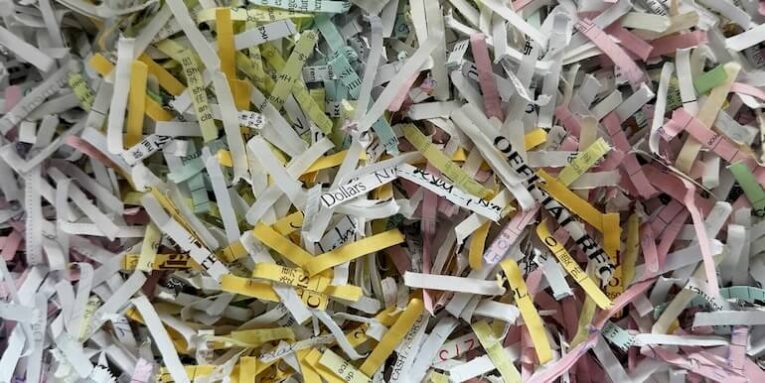
Cross-cut shredding reduces paper to the kind of fragments that no one can practically reassemble; no organization, identity thief, or state actor could put the paper that exits the shredding process to informational use. It has no informational value. It has only recyclable material value. And that material goes back into the supply chain.
Recycling one ton of paper saves approximately 17 mature trees, 7,000 gallons of water, and 4,100 kilowatt-hours of electricity (U.S. Environmental Protection Agency). Organisations that produce high volumes of paper waste and turn to secure shredding and recycling aren’t making a marginal environmental contribution when they do so. They’re making a measurable one.
The Case For a Shred-All Policy
An operational fix that’s underutilized for most organizations is just removing the judgment call entirely. Because the reality is, when you ask people to use their judgment about whether a piece of paper should go in a secure disposal stream or can be tossed in the general recycling, mistakes just happen. People don’t always know what’s actually sensitive. They’re busy. The recycling bin is right there, so that’s just easier. A shred all policy takes that decision away and just says every piece of paper goes into this console here. No sorting, no classification, no individual risk assessment.
What that does is not only remove human error from your compliance exposure, it also ensures that more of your paper waste is captured in the recycling stream rather than the general waste stream. A clean desk policy goes hand in hand with this. If the workflow is paper goes in the console, console gets emptied by the shredding provider, paper gets recycled, people will generally follow that consistently without needing to use their judgment about the confidentiality of each document every time they dispose of a piece of paper.
Verification Matters For Both Compliance and ESG Reporting
A Certificate of Destruction goes beyond being a necessary piece of bureaucracy. It is the report that finalizes the circle in terms of both data protection logistics and environmental documentation. It details what has been disposed of, when this took place, and the methods used to do so. This provides a solid basis for an audit, should either a regulator or an ESG auditor pose questions.
For those organizations working towards zero-waste-to-landfill objectives, this audit trail is vital. For sustainability managers reporting under ISO 14001 or their broader CSR criteria, this report is an important part of demonstrating that an organization’s waste is being treated and taken care of rather than just dumped.
Data privacy and sustainability aren’t challenges that are driving your organization’s waste strategy in different directions. In fact, the two are mutually beneficial and are both demanding the same approach, namely, a managed, auditable, confidential shredding program that destroys waste paper containing personal data and introduces it back into a secure recycling chain.
People also read this: How Premium Steakhouses Cook Cuts to Perfection Every Time
